Author
by Luminis Health

Log in with MyChart
Access personalized site features & view your health records.
Learn more about MyChartDon’t have a MyChart account?
Your Account
Go to MyChart
Messages
Billing Summary
Find Care
Schedule Appointment
My Care Team
My Record
Appointments
Medications
Insurance Summary
Log in with MyChart
Access personalized site features & view your health records.
Learn more about MyChartDon’t have a MyChart account?
Hello,
Go to MyChart
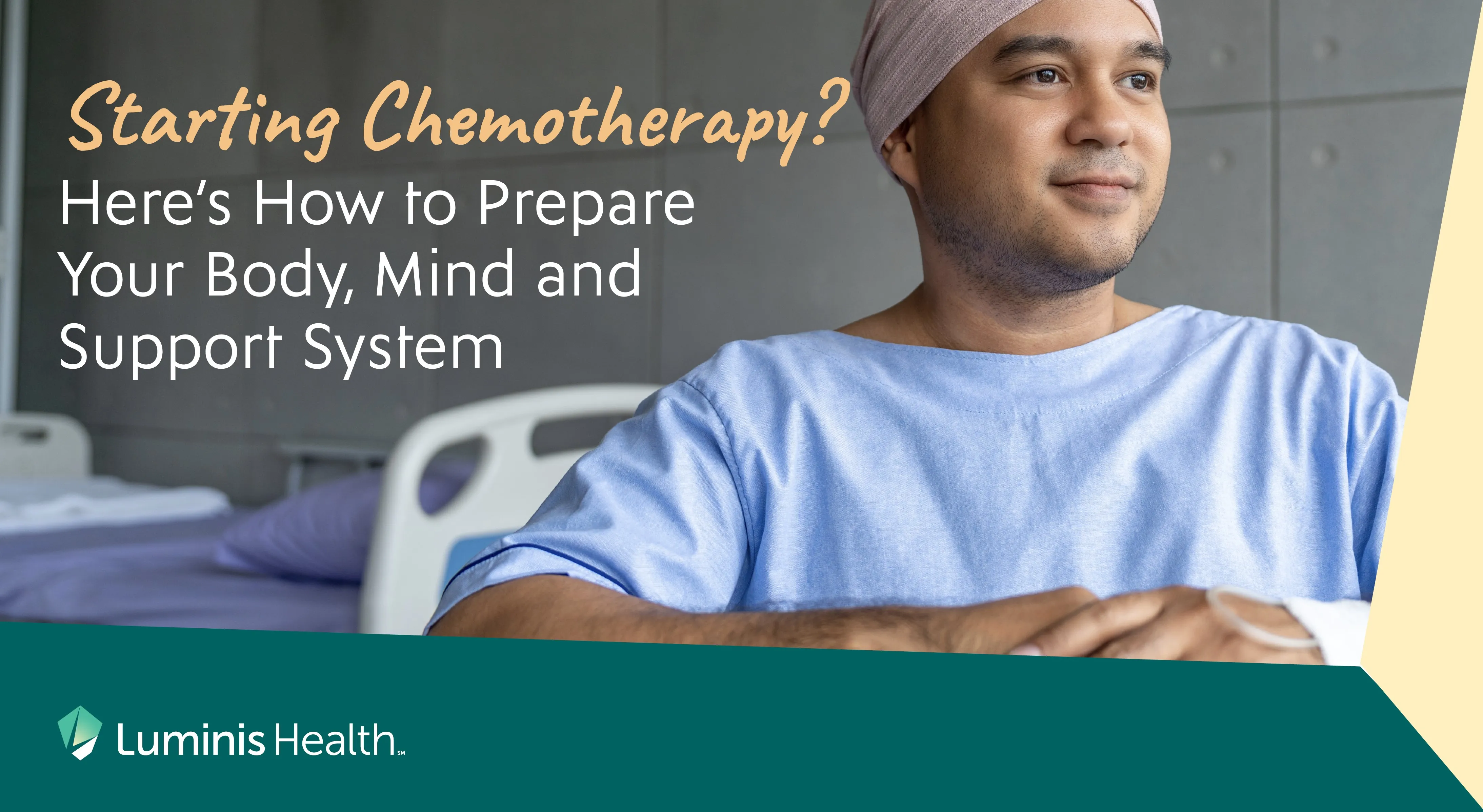
If you’re preparing for your first chemotherapy treatment, it’s normal to have questions about what’s ahead. Knowing what to expect—and how to prepare—can help you feel more focused and in control.
Most treatments take place in an infusion center or hospital and last a few hours. Consider wearing comfortable, loose-fitting clothing and bring these items with you:
When you arrive at one of Luminis Health’s two infusion centers, a member of your care team will get you settled and review your treatment plan. If you’re receiving chemotherapy through an IV, a nurse will place a small needle into a vein, usually in your arm. If you have a port, they will access it instead. You may feel a quick pinch or slight pressure during this step.
Once your treatment begins, the medication will slowly flow into your bloodstream, while you sit or lie in a comfortable chair. Most don’t feel the medication as it enters their body, but some experience mild sensations, such as coolness during the IV infusion or a metallic taste in their mouths.
If you feel uncomfortable at any point, let your care team know right away.
Chemotherapy can cause side effects because it targets fast-growing cells in your body. While the side effects may sound unpleasant, many of them can be managed with simple strategies. Here are some common side effects, and what you can do to feel more comfortable:
You don’t have to go through chemotherapy alone. Family, friends and caregivers can play an important role in supporting you during treatment. Talk openly with the people you trust about your experiences and be specific about your needs.
A wide range of medical and community resources can also help you through treatment and support your overall well-being. Support groups can connect you with people who understand what you’re going through. A Luminis Health social worker can help you find a group that’s the right fit for you, and connect you to a variety of resources.
Some side effects are expected, but others may need medical attention.
Contact your care team if you experience any symptoms that concern you, including:
If something doesn’t feel right, ask questions or check in with your medical team.
As you prepare for chemotherapy, remember that you’re not alone — and that each treatment is a step toward healing. During National Cancer Survivors Month, we recognize the strength of those undergoing and completing their treatment.
To learn more about chemotherapy at Luminis Health, please click here.
 Samah Nassereddine, MD, is an associate program director for the hematology oncology fellowship at Luminis Health Anne Arundel Medical Center.