Author
by Luminis Health

Log in with MyChart
Access personalized site features & view your health records.
Learn more about MyChartDon’t have a MyChart account?
Your Account
Go to MyChart
Messages
Billing Summary
Find Care
Schedule Appointment
My Care Team
My Record
Appointments
Medications
Insurance Summary
Log in with MyChart
Access personalized site features & view your health records.
Learn more about MyChartDon’t have a MyChart account?
Hello,
Go to MyChart
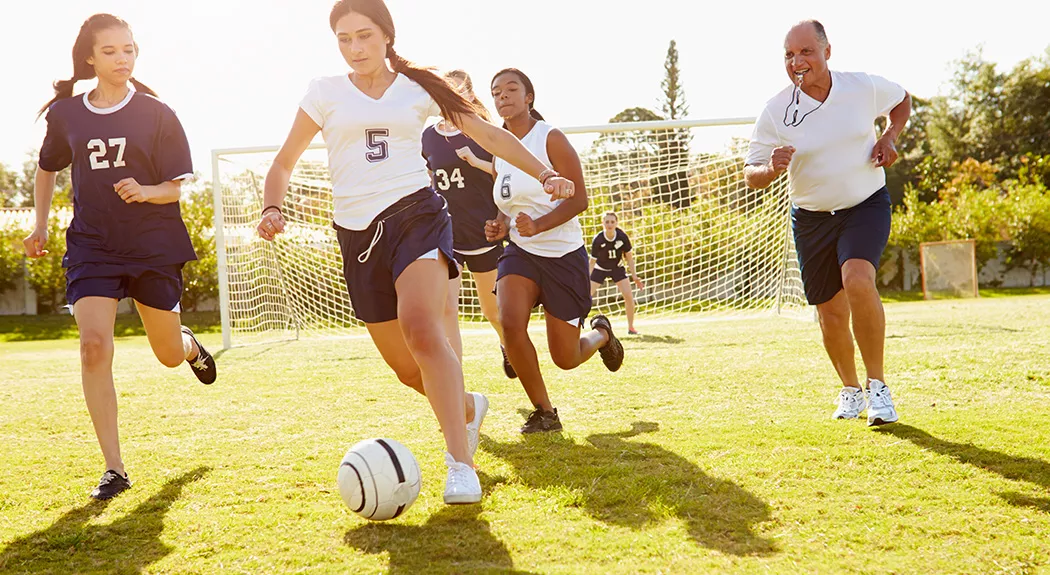
When it comes to back-to-school sports injury prevention, we hear a lot about how to protect our young athletes from sports-related injuries. As a former quarterback and now team doctor for several local college and high school football teams, as well as the Chesapeake Bayhawks, I know there’s good reason for these safety precautions.
But as an orthopedic surgeon and father of a daughter, I know there’s a fact that parents of our young female athletes need to know: Female athletes are up to eight times as likely to suffer an anterior cruciate ligament (ACL) injury as male athletes.
In fact, a recent University of North Carolina School of Medicine study found a sharp 59 percent increase in the number of ACL reconstruction surgeries performed in females aged 13 to 17 in the last 13 years.
The ACL runs diagonally in the middle of each knee. It controls rotational movement and prevents the tibia from sliding out in the front of the femur. A torn ACL is a serious, potentially career-ending sports injury.
Surprisingly, more than two-thirds of ACL injuries involve little or no contact with another player. The rates of ACL injuries are higher for jumping and cutting sports. These include soccer, basketball, volleyball and lacrosse. Non-contact ACL injuries result from things like:
I start seeing these injuries appear in my office as female athletes enter puberty. In order to help prevent these injuries, it’s important to understand the hormonal changes and anatomical differences between boys and girls that develop during puberty.
Boys entering puberty are flooded with testosterone, which allows them to more easily add lean muscle mass and lose body fat. Added muscle often makes them stronger, but less flexible.
On the other hand, the increased estrogen levels that girls experience makes their ligaments lax. Girls often have better overall body flexibility compared to boys. While this increased flexibility can be a competitive advantage, it can lead to increased risk of injury if there isn’t enough muscle to keep joints in stable, safe positions.
Estrogen also has less of an effect than testosterone on lean muscle mass gains, and actually increases body fat percentage in females going through puberty. This combination of increased laxity, less lean muscle mass gains and higher body fat percentage is thought to be related to the greater rate of ACL tears in female athletes.
Is there a way to identify females at an increased risk for ACL tears? Yes, there’s a two-legged jump test that a coach, trainer or parent can give:
Athletes at risk can start jump training and other strengthening exercises to help decrease their risk of ACL tears.
Other preventative measures include:
Many female athlete ACL injuries can be prevented with early detection and putting into practice strength and stability training.
 Daniel Redziniak, MD, is an orthopedic surgeon with Luminis Health Orthopedics and is board-certified in sports medicine. His office can be reached at 410-268-8862.
Originally published Aug. 14, 2017. Last updated July 8, 2019.